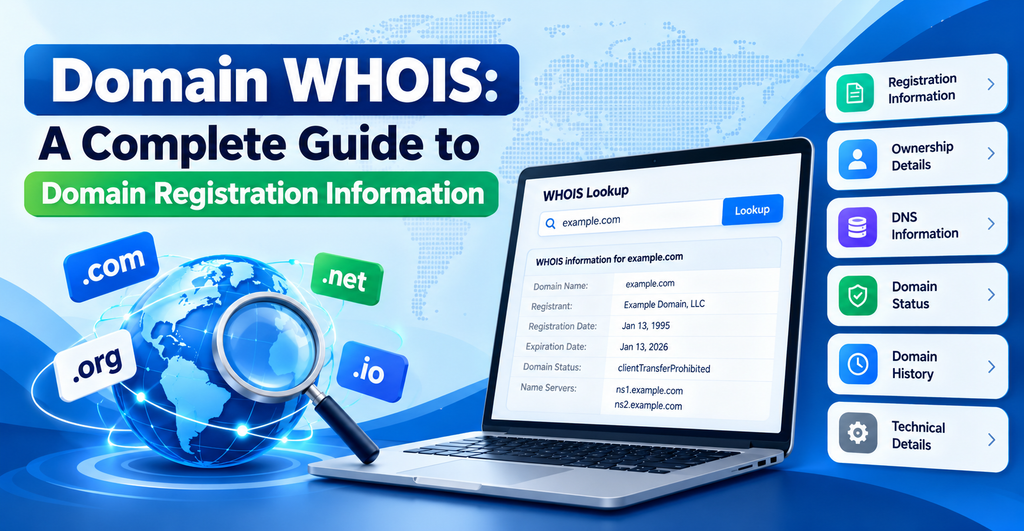
A Domain WHOIS lookup helps you check the registration information connected to a domain name. It can reveal the registrar, registration date, expiration date, nameservers, domain status, and sometimes ownership-related details when that information is publicly available.
WHOIS is useful when researching a domain before purchase, checking whether a domain is active, preparing a transfer, investigating registration problems, or confirming where a domain is managed. It gives you administrative information about the domain rather than a complete picture of the website itself.
Table of Contents
ToggleWhat Is Domain WHOIS?
Domain WHOIS is a registration information system used to retrieve public data about domain names. When a domain is registered, the registrar and registry maintain records related to that registration.
A WHOIS lookup can help you identify:
- The registrar managing the domain
- When the domain was created
- When the registration expires
- Which nameservers are assigned
- Whether the domain is locked
- Whether the domain is active, expired, or in another lifecycle stage
- Whether registrant information is publicly visible
The amount of information available varies by domain extension, registry, registrar, and privacy policy.
WHOIS should not be confused with DNS lookup. WHOIS focuses mainly on registration data, while DNS lookup focuses on technical records used to route website and email traffic.
Why Is Domain WHOIS Important?
WHOIS gives you a quick view of a domain’s administrative condition. This can be useful before buying, transferring, or troubleshooting a domain.
For example, you may discover that a domain is close to expiration, locked against transfer, or using nameservers that do not match the expected configuration.
Common uses include:
- Checking registrar information
- Reviewing domain age
- Checking expiration dates
- Investigating transfer restrictions
- Verifying nameservers
- Researching a domain before purchase
- Examining expired domains
- Confirming registration status
- Reviewing public ownership information
For businesses managing multiple domains, WHOIS can also help identify registration records that need attention.
What Information Can a WHOIS Record Contain?
A WHOIS record may contain several fields, although not every field is always public.
Typical information includes:
- Domain name
- Registrar
- Registry domain ID
- Creation date
- Updated date
- Expiration date
- Domain status
- Nameservers
- Registrar contact information
- Registrant organization
- Registrant contact information
- Technical contact information
Personal fields are frequently hidden or redacted.
The most consistently useful information is usually the registrar, dates, nameservers, and domain status.
What Is the Domain Registrar?
The registrar is the company responsible for managing the domain registration.
It normally handles:
- Domain renewal
- Registrar transfers
- Domain locking
- Authorization codes
- Contact details
- Registration settings
WHOIS can usually identify the registrar even if the owner’s identity is private.
Knowing the registrar can be useful if you are trying to determine where a domain is managed or why a transfer is failing.
Registrar vs Registry
A registrar and registry are different.
The registrar sells and manages domain registrations for customers. The registry maintains the central database for a specific domain extension.
For example, when a user registers a domain, the registrar sends registration information to the appropriate registry.
This distinction matters because WHOIS or RDAP data may contain information from both sources.
What Does the Creation Date Mean?
The creation date shows when the domain entered the registry.
It can help you understand how long the domain has existed, but it does not prove that the current website or owner has been present since that date.
A domain may have:
- Changed ownership
- Been parked
- Redirected elsewhere
- Hosted several unrelated websites
- Remained inactive
For domain research, creation date should be combined with historical website and backlink analysis.
What Does the Expiration Date Mean?
The expiration date indicates when the current registration term is scheduled to end.
If the domain is not renewed, it may eventually stop working. This can affect the website, email, subdomains, and any applications using that domain.
An expired domain does not normally become available immediately. It may move through several recovery and deletion stages first.
For important websites, domain renewal should be monitored separately from website hosting renewal.
What Is the Updated Date?
WHOIS records often contain an updated date.
This indicates that some part of the domain registration record changed. It could relate to:
- Registrar information
- Nameservers
- Status codes
- Registrant data
- Renewal information
However, the updated date does not always explain what was changed.
It is best treated as an indicator that some registration-level modification occurred.
What Are Nameservers in WHOIS?
Nameservers identify the DNS servers responsible for the domain.
For example:
ns1.examplehost.com
ns2.examplehost.com
They help indicate where the domain’s DNS zone is managed.
However, nameservers do not always reveal the hosting provider. A domain may use a dedicated DNS provider, CDN, or security service while the website is hosted elsewhere.
This is why nameserver information should not be used alone to identify hosting infrastructure.
What Are Domain Status Codes?
Domain status codes provide information about restrictions and lifecycle conditions.
They are useful when troubleshooting transfers, registration problems, or expired domains.
clientTransferProhibited
This usually means the domain is locked against transfer.
The registrar may enable this status to protect the domain from unauthorized transfers.
If you want to move the domain to another registrar, the transfer lock may need to be disabled first.
clientUpdateProhibited
This means certain registration data cannot currently be updated.
It may be applied for security or administrative reasons.
clientDeleteProhibited
This status prevents the domain from being deleted while the restriction is active.
It can provide additional protection against accidental or unauthorized deletion.
clientHold
A domain with clientHold may be removed from normal DNS publication.
This can cause the website, email, and related services to stop resolving.
The status may be connected to verification, billing, abuse, or registrar-level issues.
redemptionPeriod
This indicates that the domain has expired and entered a recovery phase.
The previous registrant may still be able to restore the domain, usually through the registrar.
Recovery can involve additional fees.
pendingDelete
A domain with pendingDelete is approaching removal from the registry.
After deletion, it may eventually become available for registration again.
Can WHOIS Reveal the Domain Owner?
Sometimes.
Older WHOIS records often exposed registrant information such as:
- Full name
- Organization
- Telephone number
- Mailing address
Today, this information is frequently hidden or redacted.
A WHOIS result may therefore show the registrar and technical details without showing the actual person or organization behind the domain.
This is normal and does not mean the domain is anonymous to the registrar.
Why Is WHOIS Information Hidden?
WHOIS information may be hidden because of:
- Privacy protection
- Registrar policies
- Registry policies
- Data protection laws
- Restricted public access rules
Many registrars now redact personal data by default.
Technical and administrative fields may remain visible even when personal ownership details are hidden.
What Is WHOIS Privacy?
WHOIS privacy prevents personal contact information from appearing publicly.
It may hide:
- Name
- Email address
- Phone number
- Postal address
The registrar still maintains the actual registrant information internally.
Privacy protection changes public visibility, not ownership or control of the domain.
Can WHOIS Tell If a Domain Is Available?
WHOIS can sometimes indicate whether a domain is registered, but availability checking is usually handled through dedicated registrar or registry lookup systems.
If no active registration exists, the domain may be available.
However, a domain that appears unregistered should always be checked again before purchase.
Availability can change quickly, and some domain extensions use different lookup systems.
How to Use WHOIS Before Buying a Domain
WHOIS should be part of your due diligence before purchasing an existing domain.
Check:
- Registrar
- Creation date
- Expiration date
- Nameservers
- Status codes
- Updated date
- Public registrant information
These details can help confirm the administrative condition of the domain.
However, WHOIS does not reveal whether the domain has a clean content or backlink history.
You should separately inspect:
- Historical content
- Backlinks
- Redirects
- Spam activity
- Trademark conflicts
- Brand history
A domain can have clean WHOIS data but still have a poor history.
WHOIS for Expired Domains
WHOIS can help you understand where an expired domain is in its lifecycle.
A typical sequence may include:
- Active registration
- Expiration
- Renewal grace period
- Redemption period
- Pending deletion
- Registry deletion
- Public availability
The exact timing varies between registries and extensions.
This means an expired domain may remain unavailable for some time.
WHOIS Before a Domain Transfer
Before transferring a domain, check its status.
Important fields include:
- Registrar
- Expiration date
clientTransferProhibitedpendingTransferclientHold
A locked domain may need to be unlocked before transfer.
You may also need an authorization code and access to the registrar account.
Checking WHOIS first can help identify obvious transfer blockers.
Can WHOIS Show the Hosting Provider?
Not reliably.
WHOIS normally identifies the domain registrar and nameservers, not the web hosting provider.
A modern website may use separate services for:
- Domain registration
- DNS
- Hosting
- CDN
- Security proxying
To investigate hosting, DNS and IP information are usually more useful.
Can WHOIS Show the Domain IP Address?
Usually not.
Domain WHOIS is focused on registration information.
To find the website’s IP address, you normally need to check DNS A or AAAA records.
For example:
example.com → 203.0.113.25That is DNS information rather than WHOIS registration data.
WHOIS vs DNS Lookup
WHOIS and DNS lookup answer different questions.
| WHOIS | DNS Lookup |
|---|---|
| Checks registration information | Checks technical DNS configuration |
| Shows registrar | Shows IP addresses |
| Shows creation date | Shows A and AAAA records |
| Shows expiration date | Shows MX records |
| Shows domain status | Shows TXT and CNAME records |
| May show registrant details | Shows service routing |
For a complete domain investigation, both are useful.
WHOIS vs Domain Lookup
WHOIS is one type of domain lookup, but domain lookup is a broader term.
A complete domain lookup may include:
- WHOIS data
- RDAP data
- DNS records
- IP addresses
- Nameservers
- Email records
- Availability status
WHOIS focuses mainly on registration.
If you need to understand the complete technical setup, WHOIS alone is not enough.
WHOIS vs RDAP
RDAP stands for Registration Data Access Protocol.
It is a newer protocol designed to provide structured registration data.
Traditional WHOIS usually returns plain-text information. RDAP returns structured data that is easier for software and APIs to process.
RDAP may include:
- Registrar
- Registration dates
- Domain status
- Nameservers
- Registry information
Modern domain tools increasingly use RDAP alongside or instead of traditional WHOIS.
WHOIS for SEO Research
WHOIS can provide background information during SEO research, but its role is limited.
Useful fields include:
- Domain creation date
- Registrar
- Expiration date
- Nameservers
- Registration status
However, none of these fields directly measures SEO strength.
SEO performance depends more directly on:
- Content quality
- Backlinks
- Crawlability
- Indexation
- Technical performance
- Internal linking
- Search intent
- Site architecture
An old WHOIS creation date alone does not make a domain authoritative.
Does Domain Age Matter for SEO?
Domain age should not be treated as a standalone ranking advantage.
An older domain may have accumulated useful assets such as backlinks, brand mentions, and historical content.
But it may also have a poor history involving:
- Spam
- Thin content
- Unrelated topics
- Manipulative redirects
- Low-quality backlinks
The important factor is the quality of the domain’s history, not simply its age.
A newer domain with stronger technical SEO and better content can still outperform an older domain.
WHOIS for Brand and Trademark Research
WHOIS can help during brand research by showing when a domain was registered and which registrar manages it.
This may be useful when investigating similar domain names or potential brand conflicts.
You can review:
- Registration date
- Registrar
- Nameservers
- Public registrant information
- Status
However, WHOIS does not determine legal ownership of a trademark.
Trademark research should be handled separately from domain registration research.
WHOIS for Security Monitoring
WHOIS can help detect unexpected domain-level changes.
Changes worth reviewing include:
- New registrar
- Changed nameservers
- New status codes
- Updated registration dates
- Transfer activity
Unexpected changes may result from normal administration, but they can also indicate unauthorized activity.
For important domains, registrar accounts should use strong authentication and transfer protection.
Common WHOIS Lookup Mistakes
WHOIS data is easy to misinterpret.
Common mistakes include:
- Assuming registrar and host are the same
- Assuming hidden ownership is suspicious
- Treating creation date as an SEO score
- Assuming expired means available
- Assuming nameservers identify the origin server
- Using WHOIS alone to value a domain
- Ignoring domain status codes
WHOIS is most useful when combined with DNS, history, backlink, and brand research.
How to Read a WHOIS Record
A practical WHOIS review can follow this order:
- Confirm the domain name.
- Identify the registrar.
- Check the creation date.
- Review the updated date.
- Check the expiration date.
- Review domain status codes.
- Verify nameservers.
- Review public registrant details if available.
- Compare the information with DNS data when needed.
This gives you a clear picture of the domain’s administrative state.
Frequently Asked Questions
What is Domain WHOIS?
Domain WHOIS is a system used to retrieve public registration information associated with a domain name. It may show the registrar, creation date, expiration date, nameservers, status codes, and some ownership-related information.
Can WHOIS show the owner of a domain?
Sometimes. Personal details may be visible, but many domains use privacy protection or data redaction that hides registrant information.
Can WHOIS show when a domain expires?
Yes. The expiration date is commonly included in domain registration records.
Can WHOIS tell me which registrar manages the domain?
Yes. Registrar information is one of the most commonly available WHOIS fields.
Is WHOIS the same as DNS lookup?
No. WHOIS focuses on registration data, while DNS lookup focuses on technical records such as A, AAAA, MX, TXT, and CNAME records.
Can WHOIS show where a website is hosted?
Not reliably. Nameservers may provide clues, but DNS and IP analysis are usually required to investigate hosting.
Can WHOIS help before buying a domain?
Yes. It can help verify registration dates, registrar information, domain status, nameservers, and expiration details before purchase.
Why is WHOIS information sometimes private?
Privacy services, registrar policies, registry rules, and data protection requirements can limit public access to personal registration information.
Conclusion
A Domain WHOIS lookup provides important registration information about a domain, including its registrar, creation date, expiration date, nameservers, and current status. It is useful for domain research, transfer preparation, expiration checks, security monitoring, and ownership-related investigations.
WHOIS becomes more useful when combined with DNS, backlink, historical, and branding research. Registration data explains the administrative state of a domain, while the additional checks help you understand its technical setup, past use, and overall suitability.